
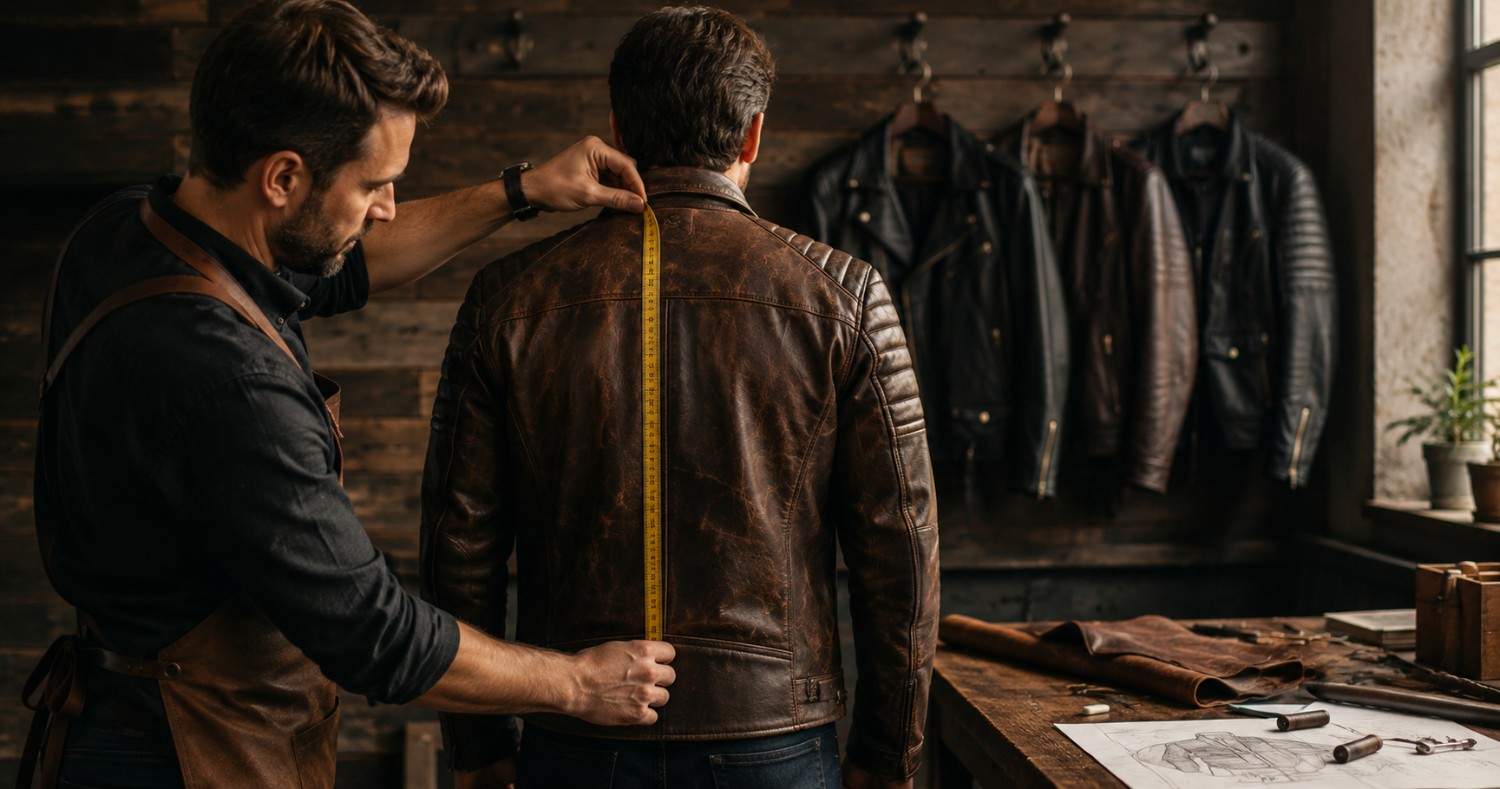
Let’s be real buying a leather jacket online is a high-stakes game. You find the perfect piece, imagine yourself looking like an absolute rockstar, and hit “Buy Now” with pure excitement. Then, the package arrives. You open it up, slide your arms in, and reality hits you like a cold wave. It’s tight enough across the shoulders to cut off your circulation, or the sleeves completely swallow your hands, making you look like you borrowed your older brother’s clothes.
Suddenly, your dream vibe turns into a frustrating chore. You’re packing it back into the box, hunting for a printer to get a return label, and waiting weeks for a refund. It sucks, and it completely ruins the joy of shopping.
But here’s the good news: you don’t need a personal tailor or a fashion degree to escape this cycle. Armed with a $2 flexible measuring tape, a mirror, and about ten minutes of your time, you can pull off flawless DIY measurements. This guide skips the generic sizing charts that leave you guessing between a Medium and a Large. Instead, we are breaking down a bulletproof, step-by-step method to nail your exact dimensions on the very first try. No corporate jargon. No complicated math. Just pure, actionable advice to get that custom-fit feeling.
Why Standard Sizing Charts Are Gaslighting You
Here is the brutal truth about the online clothing world: size is an illusion. If your closet is packed with Medium T-shirts and hoodies that fit perfectly, your brain automatically tells you to order a Medium leather jacket. Do that, and you are almost guaranteed to end up with a jacket that doesn’t fit.
Unlike stretchy hoodies, oversized sweatshirts, or knit tees, leather has zero give. It doesn’t forgive, and it definitely doesn’t stretch to accommodate a bad guess. To make matters worse, fast fashion brands and premium labels all live in completely different sizing universes. A “Medium” in a slim-fit European brand might feel like an Extra Small in an American streetwear label.
Standard sizing charts on websites don’t help much either. Most of them just throw a single “Chest” number at you without explaining how to get that number. Do you measure under your arms? Do you inhale or exhale? What about your shoulder width or sleeve length? When brands ignore these crucial details, customers end up playing roulette with their money. Spending less than ten minutes to map your body accurately isn’t just about avoiding a return; it’s about making sure your hard-earned money buys a piece that looks expensive, structured, and custom-tailored to your frame.
The No-Nonsense Pre-Measurement Checklist
Before you grab your tape measure, you need to set the stage. Measuring yourself the wrong way is actually worse than not measuring at all because it gives you false confidence.
First, get the right tool. You need a soft, flexible tailoring tape. If you try to use a metal construction tape measure, it won’t wrap around your body shape, and your numbers will be completely warped. If you don’t have one, strip a piece of string around your body, mark it, and lay it flat against a regular ruler.
Second, check your layers. Strip down to a basic, lightweight T-shirt. If you take your measurements while wearing a thick, chunky knit sweater or a heavy fleece hoodie, you are adding two to three phantom inches to your actual frame. This will result in an oversized, baggy jacket that loses its edge.
Finally, fix your posture. Stand naturally. Don’t puff your chest out like a gym bro, and don’t suck your stomach in. You want the jacket to fit your everyday, relaxed body—not a stiff, uncomfortable pose you can only hold for thirty seconds in front of a mirror. If you have a friend nearby, grab them to help. If not, just stand right in front of a full-length mirror so you can double-check your tape alignment.
How to Measure Your Chest (The Ultimate Anchor Point)
Your chest measurement is the most critical number on any size chart. It determines whether your jacket will actually zip up comfortably or feel like a straightjacket.
To get it right, wrap the soft measuring tape around the widest, fullest part of your chest. This usually runs directly across your nipples and right under your armpits. Make sure the tape stays perfectly level across your back. If the tape sags at the back, your reading will be too large, leading to a baggy fit.
Here is the secret trick that AI tools and basic charts never tell you: take a normal, relaxed breath right before you read the number. Do not hold your breath in to look leaner, and do not deeply inhale to look bigger. Slide one finger flat under the tape measure while it’s against your chest. This creates a tiny bit of “breathing room” or ease, ensuring that when your jacket arrives, you can move, drive, and sit down without feeling restricted. Write this number down immediately before moving on.
How to Measure Your Shoulders (Where the Structure Lives)
If the chest measurement determines the volume, the shoulder measurement determines the entire silhouette of the jacket. If a jacket’s shoulders are too wide, the seams will droop down your arms, making you look sloppy. If they are too narrow, your arm movement will be completely locked down.
Finding your shoulder point is simple. Feel the top of your shoulder with your fingers until you find the hard, bony point where your shoulder ends and your arm naturally begins to slope downward. This is your seam anchor.
Start the tape measure exactly at that bony point on your left shoulder. Run it straight across the natural curve of your upper back, over your shoulder blades, until you hit the exact same bony point on your right shoulder. Keep the tape taut but do not pull it tight. If you are doing this solo, look directly into the mirror to make sure the tape isn’t riding up your neck or slipping down your back. A perfectly fitted leather jacket should have its shoulder seams sitting exactly on these bony landmarks.
How to Measure Sleeve Length (No More Wizard Sleeves)
Sleeve length is a massive make-or-break factor for leather jackets. Unlike a fabric jacket or a hoodie, you can’t easily roll up leather sleeves if they are too long, and altering them at a local tailor can easily cost you over $100.
To measure this accurately, don’t lock your arm completely straight down your side. Instead, let your arm hang naturally with a very slight, relaxed bend at the elbow.
Place the start of the tape measure at that same bony shoulder point you located in the previous step. Guide the tape down the outside curve of your arm, passing over your elbow, and stop right at your wrist bone (or the base of your thumb, depending on how much coverage you prefer). As a rule of thumb, a great leather jacket sleeve should hit right where your hand meets your wrist. When you raise your arms to drive or ride a bike, the sleeves will naturally pull back a bit, which is completely normal. If your measurement stops short of the wrist bone, your wrists will feel completely exposed to the wind.
The Crucial Extras: Jacket Length and Waist Mapping
Most people stop after chest, shoulders, and sleeves, but if you want a truly flawless look, you need two more quick numbers: jacket length and waist size.
Jacket Length
Leather jackets are meant to sit much higher on the body than regular denim jackets or parkas. To measure your ideal length, place the tape at the very top of your shoulder (right where your neck meets your shoulder seam). Let the tape hang straight down your front. Look in the mirror and note where the numbers hit your waistline.
For a classic, cropped biker or bomber jacket vibe, the tape should stop right at your belt line or the upper hip. If you prefer a more modern, casual everyday jacket, it can hang an inch or two below the belt. Anything lower than that starts looking like a trench coat, losing that sharp, cropped aesthetic.
Waist Measurement
Don’t confuse your pants size with your actual waist measurement. Wrap the tape around your midsection, roughly an inch above your belly button. This is your natural waistline.
This number is incredibly important if you are eyeing a slim-fit, tapered asymmetrical biker jacket. Many premium jackets taper sharply from the chest down to the waist. If you have an athletic or straight build, a jacket that fits your chest might be way too tight around your stomach if you don’t cross-reference this specific waist number with the brand’s guide.
3 Rules for Translating Your Numbers to the Size Chart
Now that you have your master list of numbers written down, you are ready to open that online store. But don’t just match your numbers blindly. Apply these three final filtering rules to guarantee a perfect match.
First, identify what kind of chart the brand is using. Some brands list Body Measurements (meaning they are showing the size of the human body that fits the jacket), while other brands list Garment Measurements (meaning they measured the actual leather flat on a table). If it’s a garment measurement chart, you need to add roughly 2 to 3 inches to your actual chest measurement so you can actually fit inside the leather layer. When checking out our latest arrivals at Charles Wear New Arrivals, always cross-reference your exact body chest size with our specific size charts.
Second, think about your personal styling and layering habits. Do you live in a cold climate where you plan to wear heavy hoodies or cardigans under this jacket? If yes, size up or pick a regular fit. If you live somewhere warmer and only plan to rock it over a vintage graphic tee for a sleek, slim silhouette, stick exactly to your true measured size.
Third, look for real-world validation. Dive into the customer review section or check Reddit threads for that specific brand. Look for phrases like “runs small” or “size up for layering.” Combining your fresh, accurate measurements with real customer feedback completely removes the element of luck from the equation.
Conclusion: Measure Once, Wear with Confidence
An iconic piece built from Top Quality Genuine Leather is an investment that should last you a decade, if not a lifetime. It’s not just about buying premium full-grain leather or a killer design; it’s entirely about how that leather frames your body. Taking ten minutes to step away from the screen, grab a measuring tape, and properly log your chest, shoulders, sleeves, and waist completely changes how you shop online.
You no longer have to rely on guesswork, cross your fingers during checkout, or deal with the headache of mail-back returns. You get to order with absolute certainty. Grab that measuring tape today, log your numbers, find your match on the size chart, and get ready to rock a jacket that feels like it was custom-molded just for you from the very first try.


 No products in the cart.